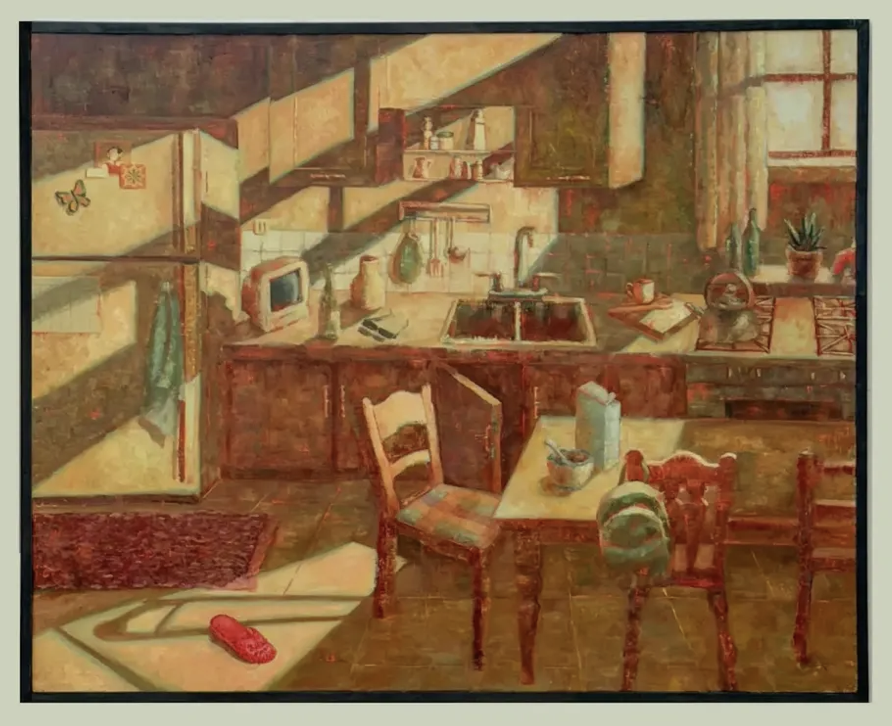
Alika Lazarus – Kitchen
€3.000,00
Tecnica: Olio su tela
Anno: 2026
Alika Lazarus – Kitchen
ITA
In Kitchen (2026), la tensione è immediata, nonostante l’assoluta immobilità della scena. A determinarla è innanzitutto la luce: intensa, quasi teatrale, trasforma l’interno domestico in una sorta di palcoscenico. Tutto sembra fissato in un istante sospeso.
È allora che, poco a poco, si delinea una possibile narrazione. Sul piano della cucina sono rimasti un paio di occhiali; scatole di cereali e cibo non sono stati riposti; le ante dei pensili sono aperte; uno zaino pende da una sedia. A terra, infine, una sola pantofola rossa. Sono dettagli del tutto ordinari, ma il loro accumularsi suggerisce una successione di gesti appena interrotta. Delle persone, invece, nessuna traccia.
Eppure tutto lascia pensare che fossero lì fino a un attimo prima.
È proprio questo a conferire all’apparente immobilità di Kitchen la sua particolare tensione. La pantofola evoca il piede che la indossava; gli occhiali, qualcuno che li ha appena posati; l’anta aperta, il gesto che l’ha lasciata così. Gli oggetti non sostituiscono le figure assenti, ma conservano la traccia delle loro azioni. L’assenza diventa percepibile proprio perché la presenza sembra ancora così vicina.
L’effetto ricorda quello della persistenza retinica, per cui un’immagine continua per un istante a essere percepita anche quando ciò che l’ha prodotta non è più davanti ai nostri occhi. Lazarus sembra ottenere qualcosa di analogo con la presenza umana. I corpi sono scomparsi, ma i loro gesti sembrano ancora sospesi nella stanza. Gli oggetti sono rimasti dove sono stati lasciati, l’anta è ancora aperta e persino l’aria sembra trattenere qualcosa del movimento che l’ha appena attraversata.
Questa sensazione trova un’eco sorprendente nelle parole con cui Lazarus descrive il proprio lavoro. L’artista parla della ricerca di un equilibrio tra energia potenziale ed energia cinetica sulla tela, anche quando «l’unico elemento in movimento è l’aria davanti a lei». In Kitchen il movimento non viene mai rappresentato direttamente, eppure se ne avverte ovunque il residuo. Il dipinto si colloca precisamente in quel breve intervallo in cui l’azione si è già conclusa, ma l’immobilità non ha ancora preso completamente il suo posto.
Una tensione che non dipende soltanto dal soggetto, ma dalla pittura stessa.
Il colore ha una funzione strutturale. I toni caldi dell’ambra dominano l’interno, mentre mezze tinte verdi affiorano lungo i margini delle forme e nelle zone d’ombra. Questi rapporti cromatici non si limitano a descrivere la luce: fanno vibrare le superfici. La pantofola rossa introduce invece una nota più netta. Minuscola rispetto all’insieme della composizione, acquista, per contrasto con i verdi circostanti, un’intensità visiva del tutto sproporzionata alle sue dimensioni. Attraverso il colore, un dettaglio domestico apparentemente insignificante diventa una delle presenze più forti del quadro.
Più incerta è invece la costruzione dello spazio. Gli occhiali sembrano quasi sospesi sul piano della cucina, la prospettiva qua e là si allenta e alcune forme rimangono irrisolte. C’è in Kitchen una certa ingenuità pittorica che Lazarus non cerca di dissimulare. Sarebbe tuttavia eccessivo leggere ogni irregolarità come una deformazione intenzionale: alcune appartengono semplicemente alle incertezze naturali di una pittrice ancora molto giovane. Ma è evidente che il centro della sua attenzione si trova altrove: nel colore, nell’atmosfera, nella tensione emotiva dell’immagine.
La distinzione è importante. Ciò che uno sguardo accademico potrebbe considerare un errore può semplicemente sopravvivere perché, nel quadro, qualcos’altro conta di più. E in Kitchen queste irregolarità non compromettono necessariamente la pittura. Gli occhiali quasi sospesi, alcune esitazioni prospettiche e le libertà cromatiche contribuiscono anzi a costruire un’immagine perfettamente riconoscibile e tuttavia mai del tutto stabile. Le sue imperfezioni finiscono così per diventare inseparabili dalla sua particolare vitalità.
È a questo punto che acquista pienamente senso una frase con cui Lazarus definisce il proprio lavoro: «Painting is honesty without words.» L’onestà di Kitchen non consiste in un deliberato rifiuto delle regole accademiche, né nella volontà di trasformare l’imperfezione in un programma estetico. È qualcosa di più immediato. Lazarus lascia convivere nella stessa immagine istinto, intuizione e incertezza, senza costringere il dipinto verso una sofisticazione che non appartiene ancora al suo linguaggio.
Kitchen trasforma così un interno quotidiano in una riflessione sulla presenza e sulla sua scomparsa. La sua forza drammatica non nasce da un evento rappresentato, né dalla presenza di una figura. Nasce dall’istante immediatamente successivo: quello in cui i corpi hanno già lasciato la scena, mentre gli oggetti conservano ancora la memoria dei loro gesti.
Come un’immagine che persiste per un attimo sulla retina, la presenza rimane quando chi l’ha prodotta è già scomparso.
Nulla si muove. Eppure tutto vibra.
ENG
In Kitchen (2026), the sense of drama is immediate, although the scene itself is completely still. Light plays an essential role in creating this tension. Strong and almost theatrical, it gives the interior the dramatic intensity of a stage under the lights. The painting seems to capture a moment suspended in time.
Under this light, a narrative begins to take shape. We notice a pair of glasses left on the counter, cereal boxes and food still out, cupboard doors left open, a backpack hanging from a chair. And then, on the floor, a single red slipper. These are ordinary details, yet their accumulation suggests an interrupted sequence of actions. The people themselves are nowhere to be seen.
Everything suggests that they were here only moments ago.
This is what gives the apparent stillness of Kitchen its particular tension. The slipper implies the foot that occupied it; the glasses, the person who removed them; the open cupboard, the gesture that preceded our arrival. The objects do not replace the absent figures, but they retain the traces of their actions. Absence becomes perceptible precisely because presence still feels so recent.
The effect is close to persistence of vision: the phenomenon by which an image remains briefly perceptible after its source has disappeared. Lazarus produces something similar with human presence. The bodies are gone, yet their gestures seem suspended in the room. The objects have been left behind, the cupboard is still open, the air itself seems to retain the movement that has just passed through it.
This sensation finds a striking echo in Lazarus’s own description of her practice. She speaks of seeking a balance between potential and kinetic energy on the canvas, even when “the only moving element is the air in front of her.” In Kitchen, movement is never represented, but its residue is everywhere. The painting occupies that brief interval in which action has stopped without yet becoming stillness.
This tension is not produced by subject matter alone. It is built through the language of painting itself.
Colour plays a structural role. Warm amber tones establish much of the interior, while green half-tones run along edges and lines of shadow. Rather than simply describing the effects of light, these chromatic relationships make the surfaces vibrate. The single red slipper works as a sharper interruption. Small within the composition, its complementary opposition to the surrounding greens gives it a dramatic intensity far beyond its physical importance. Colour turns an incidental domestic object into one of the strongest presences in the painting.
Space is less stable. The glasses appear almost to float above the counter; perspective occasionally loosens, and certain forms remain unresolved. There is a degree of pictorial naivety in Kitchen that Lazarus makes no particular effort to conceal. It would be misleading to interpret every irregularity as a deliberate distortion. Some belong quite simply to the natural uncertainties of a young painter. Yet her attention seems to lie elsewhere—in colour, atmosphere and the emotional tension of the image.
This distinction matters. What an academic eye might identify as an error can remain simply because something else matters more. And, in Kitchen, these irregularities do not necessarily work against the painting. The floating glasses, uncertain spatial relationships and chromatic departures contribute to an image that is recognisable but never entirely stable. Its imperfections become inseparable from its particular vitality.
Only then does Lazarus’s opening statement begin to reveal its significance: “Painting is honesty without words.” The honesty of Kitchen does not lie in a calculated rejection of academic correctness, nor in turning imperfection into a strategy. It is something more immediate. Lazarus allows instinct, intuition and uncertainty to coexist within the same image. She does not force the painting towards a sophistication foreign to its own language.
Kitchen ultimately transforms an everyday interior into a meditation on presence and its disappearance. Its drama depends neither on an event being represented nor on a figure occupying the scene. It emerges in the interval immediately afterwards, when bodies have left but the objects around them still carry their gestures.
Like an afterimage retained by the eye, their presence remains for a moment after they have gone.
Nothing moves. But everything vibrates.
Solo 1 pezzi disponibili