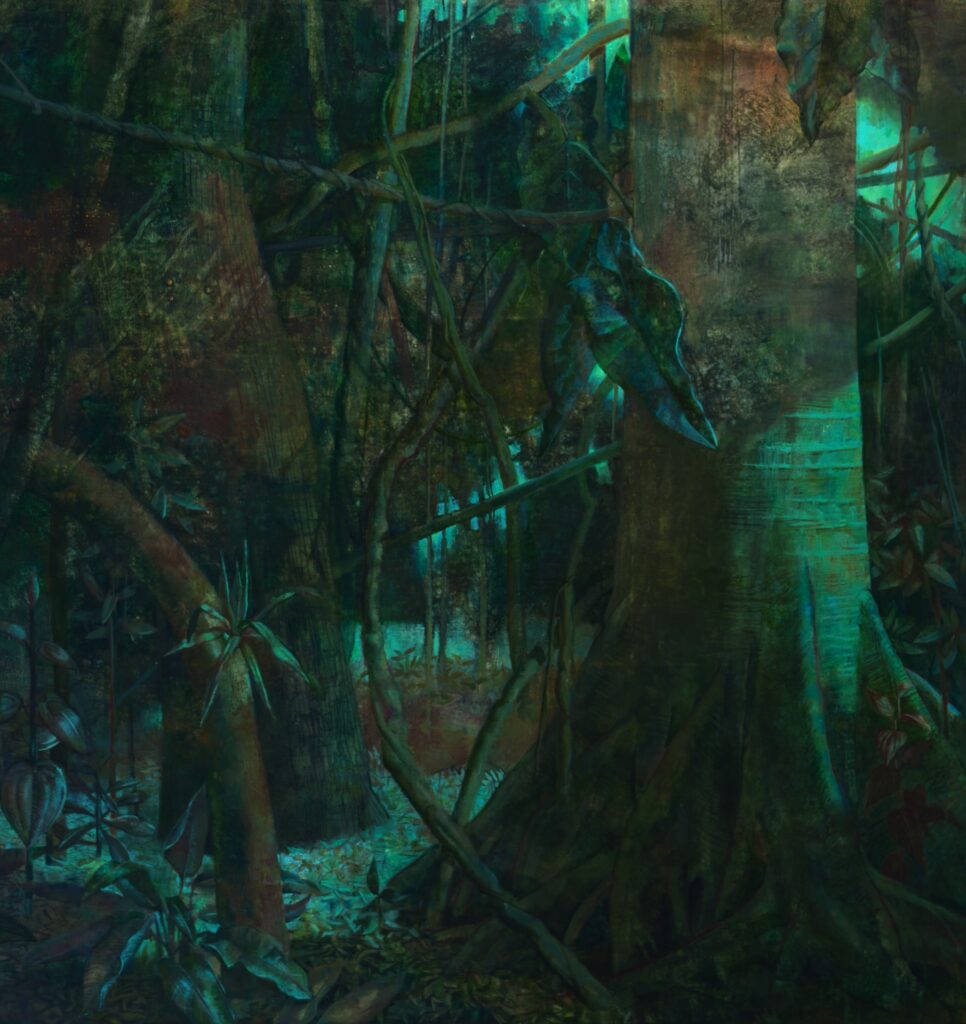
Clara D’Elia – Sapopemba
€5.000,00
Tecnica: Olio su tela
Anno: 2026
ITA
In portoghese, sapopemba è una parola di origine tupi (lingua indigena brasiliana). Indica principalmente le grandi radici tabulari che si sviluppano alla base di alcuni grandi alberi tropicali, come la ceiba.
Clara D’Elia è una pittrice brasiliana, nata a San Paolo nel 1999. È anche biologa, con una formazione in botanica. Questa doppia formazione è importante, non perché trasformi la sua pittura in illustrazione scientifica, ma perché determina il suo modo di osservare ciò che dipinge. La foresta, per D’Elia, non è semplicemente un insieme di alberi e piante: è un sistema vivente, la cui esistenza dipende dalle relazioni che si instaurano al suo interno.
Sapopemba prende il titolo da una parola di origine tupi che indica le grandi radici tabulari che si sviluppano alla base di alcuni alberi tropicali. Queste radici ancorano il dipinto alla realtà fisica della Mata Atlântica, ma offrono anche una chiave per comprenderne la composizione. Nulla, nella foresta, sembra esistere in maniera autonoma. I tronchi si incrociano, le radici si insinuano nella vegetazione circostante, le liane avvolgono e attraversano altre forme. La foresta non appare come una somma di organismi distinti, ma come una fitta rete di relazioni.
È forse qui che la formazione biologica di D’Elia emerge con maggiore evidenza. La conoscenza botanica potrebbe indurre un pittore a isolare le diverse specie per descriverle con maggiore precisione. Qui accade quasi il contrario: più attentamente si osserva la foresta, più difficile diventa separare un organismo dall’altro.
La foresta esiste precisamente attraverso le relazioni che uniscono le sue parti.
I tronchi diventano corpi. Le liane vi si tendono attorno come muscoli. Radici, rami e fogliame si sovrappongono fino a rendere incerto il confine tra una forma e l’altra. Ma sarebbe sbagliato interpretare questa interdipendenza come armonia. La foresta è anche uno spazio di competizione. Le piante crescono insieme, attorno e talvolta a discapito le une delle altre, contendendosi soprattutto lo spazio e l’accesso alla luce. Cooperazione e conflitto appartengono allo stesso sistema.
Anche la composizione obbedisce a questa logica. Non esiste un orizzonte convenzionale, né un punto di vista stabile dal quale contemplare comodamente il paesaggio. Lo spettatore non è posto davanti alla foresta: vi è immerso. Le forme entrano ed escono dal quadro, la vegetazione si accumula e lo sguardo viene continuamente condotto da una struttura all’altra. Nessun elemento riesce a imporsi definitivamente sugli altri. Come l’ecosistema che rappresenta, anche il dipinto si costruisce attraverso rapporti di interdipendenza.
Lo stesso principio è già presente nel processo pittorico di D’Elia. Anziché partire dalla descrizione delle singole piante, l’artista procede inizialmente per accumulazione di strati astratti. Colore, materia e gesto costruiscono un campo pittorico dal quale, progressivamente, emergono le forme vegetali. Tronchi, radici e liane non vengono dunque semplicemente collocati all’interno di uno spazio preesistente: prendono forma all’interno di una materia pittorica i cui diversi strati hanno già cominciato a interagire tra loro.
La foresta non è soltanto il soggetto della pittura. Il suo stesso modo di funzionare diventa un modo di costruire il quadro.
Anche il colore rafforza questa sensazione di trasformazione continua. Gran parte di Sapopemba si sviluppa attraverso un dialogo tra bruni caldi, ramati, e verdi più freddi, attraversati da tonalità azzurro-verdi che ricordano il verderame. L’associazione è particolarmente suggestiva perché il rame stesso si trasforma a contatto con l’ambiente: esposto all’aria e all’umidità, si ossida progressivamente fino a produrre tonalità verdi e azzurre. La tavolozza di D’Elia sembra suggerire un passaggio analogo da uno stato cromatico all’altro.
I colori, infatti, non servono semplicemente a definire localmente le forme, ma circolano all’interno del quadro. I bruni penetrano nei verdi, i verdi emergono dall’oscurità, mentre accenti turchesi e verde-azzurri affiorano tra la vegetazione. La foresta non viene così rappresentata come un insieme di oggetti stabili, ma come un processo continuo di trasformazione della materia.
La luce segue la stessa logica. È frammentaria, talvolta ridotta a piccole porzioni della superficie, e proprio per questo acquista un’intensità straordinaria nel contrasto con le zone d’ombra. In una foresta fitta la luce non si distribuisce uniformemente: la possibilità di raggiungerla condiziona la crescita stessa della vegetazione. D’Elia rende pittoricamente percepibile questa competizione.
La luce non è diffusa: è conquistata.
È proprio la sua rarità a conferirle forza. Quando riesce ad attraversare la densità della vegetazione, non si limita a illuminare: fa brillare. Piccoli passaggi di turchese, verde e tonalità più chiare acquistano improvvisamente un’intensità quasi minerale contro la massa più scura della foresta.
In Sapopemba, la luce non è soltanto ciò che permette di vedere la foresta: è ciò per cui la foresta lotta.
Un interessante precedente storico si può ritrovare nell’opera di Martin Johnson Heade, che nell’Ottocento viaggiò in Brasile unendo all’esperienza pittorica un’attenta osservazione della flora e della fauna tropicali. Nei suoi lavori brasiliani, lo studio diretto dell’ambiente naturale convive con la pittura senza ridursi a semplice illustrazione scientifica. In opere come Brazilian Forest (1864), osservazione botanica ed esperienza pittorica procedono insieme.
D’Elia, tuttavia, porta questa relazione in una direzione diversa. Nel suo lavoro, la conoscenza botanica non conduce a isolare le specie per descriverle meglio. Permette, al contrario, di comprendere perché sia così difficile isolarle: la foresta esiste precisamente attraverso le relazioni che le uniscono.
È una distinzione essenziale. D’Elia non dipinge semplicemente l’aspetto di una foresta. Cerca piuttosto di tradurre qualcosa del modo in cui una foresta esiste: attraverso l’accumulazione, l’interdipendenza, la competizione, la trasformazione e una continua negoziazione dello spazio e della luce.
Sapopemba è quindi meno un paesaggio osservato dall’esterno che un ambiente vissuto dall’interno. La sua densità impedisce di prenderne le distanze. Le forme resistono all’isolamento. I colori passano da uno stato all’altro e la luce riesce ad affiorare soltanto attraverso la resistenza di tutto ciò che la circonda.
La foresta, in definitiva, è forse meno il soggetto del dipinto che il suo stesso modo di esistere.
ENG
In Portuguese, sapopemba is a word of Tupi (Indigenous Brazilian) origin. It primarily refers to the large buttress roots found at the base of giant tropical trees, such as the kapok tree (ceiba).
Clara D’Elia is a Brazilian painter born in São Paulo in 1999. She is also a biologist, trained in botany. This double background is important, not because it turns her painting into scientific illustration, but because it shapes the way she understands what she sees. She does not approach the forest simply as a collection of trees and plants. She understands it as a living system, structured by relationships.
Sapopemba takes its title from a word of Tupi origin referring to the large, angular buttress roots that grow from the base of certain tropical trees. These roots anchor the painting in the physical reality of the Mata Atlântica, but they also provide a key to understanding its composition. Nothing in the forest seems to exist independently. Trunks intersect, roots spread into the surrounding vegetation, vines wrap themselves around other forms. The forest is not presented as an accumulation of separate organisms, but as a dense network of relations.
This is perhaps where D’Elia’s knowledge of biology becomes most visible. Botanical knowledge could lead a painter to isolate species in order to describe them more precisely. Here, it produces almost the opposite effect. The more closely the forest is observed, the more difficult it becomes to separate one organism from another.
The forest exists precisely through the relationships that connect its parts.
The trunks become bodies. Vines tighten around them like muscles. Roots, branches and foliage overlap until the distinction between one form and another becomes uncertain. Yet this interdependence should not be mistaken for harmony. A forest is also a place of competition. Plants grow with, around and sometimes at the expense of one another, competing above all for space and access to light. Cooperation and struggle belong to the same system.
The composition reflects this logic. There is no conventional horizon and no stable viewpoint from which the landscape can be comfortably surveyed. The spectator is not placed in front of the forest but caught inside it. Forms enter and leave the frame, vegetation accumulates, and the eye is continually redirected from one structure to another. No single element completely dominates the image. Like the ecosystem it represents, the painting is constructed through interdependence.
This principle is already present in D’Elia’s working process. Rather than beginning by describing individual plants, she first builds the painting through an accumulation of abstract layers. Colour, matter and gestures establish a pictorial field from which the vegetal forms gradually emerge. Trunks, roots and vines are therefore not simply placed upon a pre-existing space; they are formed within layers that have already begun to interact with one another.
The forest is not only the subject of the painting. The way it functions becomes a way of constructing the painting itself.
Colour reinforces this sensation of continuous transformation. Much of Sapopemba develops through a dialogue between warm, copper-like browns and cooler greens and blue-greens reminiscent of verdigris. The relationship is particularly suggestive because copper itself changes through contact with its environment: exposed to air and moisture, its surface gradually oxidises and produces green and blue tones. D’Elia’s palette seems to reproduce a similar passage from one chromatic state into another.
Rather than defining forms through fixed local colours, these tones migrate across the painting. Browns enter greens, greens emerge from darkness, turquoise and blue-green accents appear within the vegetation. The forest is therefore not represented as a collection of stable objects but as a continuous process of transformation.
Light operates according to the same principle. It is fragmentary, sometimes reduced to small areas, yet it becomes remarkably intense against the surrounding shadows. In a dense forest, light is not evenly distributed. Access to it structures growth itself. D’Elia makes this competition visible pictorially.
The light is not diffuse. It is conquered.
Its rarity is precisely what gives it force. Where it manages to penetrate the density of the vegetation, it does more than illuminate: it makes surfaces shine. Small passages of turquoise, green and pale colour suddenly acquire an almost mineral intensity against the darker mass of the forest.
In Sapopemba, light is not simply what allows us to see the forest; it is what the forest is struggling for.
There is an interesting historical echo here in the work of Martin Johnson Heade, who travelled to Brazil in the nineteenth century and combined close observation of tropical flora and fauna with painting. His Brazilian works emerged from direct study of the natural environment without becoming mere scientific illustrations. In paintings such as Brazilian Forest (1864), botanical observation and pictorial experience coexist.
But D’Elia moves in a different direction. In her work, botanical knowledge does not lead to the isolation of species in order to describe them more accurately. On the contrary, it helps us understand why isolating them is so difficult in the first place: the forest exists precisely through the relationships that connect them.
This distinction is essential. D’Elia does not simply paint what a forest looks like. She attempts to translate something of the way a forest exists: through accumulation, dependence, competition, transformation and the continuous negotiation of light and space.
Sapopemba is therefore less a landscape observed from outside than an environment experienced from within. Its density prevents distance. Its forms resist isolation. Its colours pass from one state into another, and its light appears only through the resistance of everything surrounding it.
The forest may ultimately be less the subject of the painting than its way of existing.
Esaurito