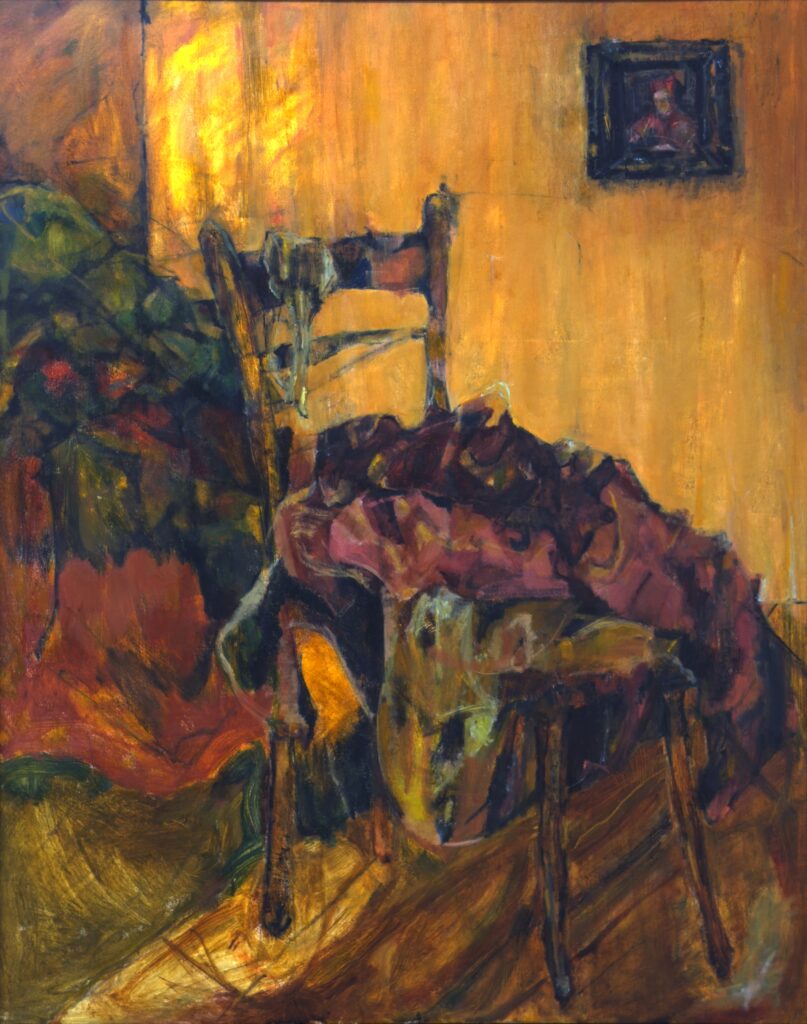
Lou Brockstedt – Yellow chair
€3.300,00
Tecnica: Olio su tela
Anno: 2026
ITA
Più che un semplice mobile, la sedia ha da tempo assunto nella pittura il ruolo di sostituto della figura umana. Segna il luogo in cui il corpo si posa, in cui il movimento si sospende e la presenza lascia la propria traccia. Pochi artisti hanno esplorato questa possibilità in modo così diretto come Van Gogh. Nei suoi celebri dipinti raffiguranti la propria sedia e quella di Gauguin, la persona scompare, eppure l’oggetto conserva una presenza sufficiente a evocare un individuo. La sedia diventa un ritratto.
Lou Brockstedt parte da questa stessa premessa, ma la rovescia con discrezione.
La sua sedia non sostituisce una persona; porta le tracce materiali di una vita. Vestiti, tessuti e oggetti quotidiani occupano il sedile, non come segni d’identità, ma come testimonianze di un legame. Più che descrivere la figura assente, parlano di tutto ciò che rimane con noi — di tutto ciò che portiamo con noi e di tutto ciò che può impedirci di andare avanti. Il ritratto non viene più trasferito su un oggetto. Viene trasferito sul peso stesso.
La sedia è forse l’oggetto domestico più intimamente legato alla gravità. Esiste per accogliere il peso del corpo, per interrompere il movimento, per permetterci di fermarci. Brockstedt conserva questa funzione eliminando però completamente il corpo. Ciò che rimane è un denso accumulo di cose, la cui massa fisica rispecchia la loro carica emotiva. Come ha osservato l’artista, l’accumulo materiale può diventare un’ancora. Il dipinto conferisce a questa idea una forma tangibile.
Questa sensazione non è prodotta soltanto dal soggetto. È costruita attraverso il linguaggio stesso della pittura. Gli oggetti sprofondano pesantemente nella sedia, e la loro densità è rafforzata dalla pennellata. La gravità agisce due volte: letteralmente, attraverso il peso degli oggetti, e psicologicamente, attraverso il peso della memoria e dell’attaccamento. Il dipinto non illustra queste idee: le incarna.
Il colore svolge un ruolo altrettanto strutturale. Prima ancora di descrivere gli oggetti, stabilisce l’architettura dell’immagine. Un’ampia distesa di giallo caldo tiene insieme la composizione, mentre ocra, marroni, rosa attenuati e grigio-azzurri si raccolgono intorno alla sedia in dense masse cromatiche. Le forme emergono attraverso rapporti di colore piuttosto che attraverso contorni precisi. Sotto questo aspetto, l’approccio di Brockstedt ricorda Frank Auerbach, i cui dipinti sono strutturati dall’equilibrio delle masse cromatiche prima ancora che queste si risolvano in oggetti riconoscibili. Qui il colore non è descrittivo; è costruttivo.
Solo allora un’altra immagine comincia a rivelarsi. In alto, in un angolo, è appesa una piccola riproduzione del Ritratto del cardinale Gaspar de Borja y Velasco di Velázquez. È facile non notarla, eppure modifica sottilmente la lettura dell’intero dipinto. Nel ritratto di Velázquez, l’autorità del personaggio mette in secondo piano la sedia sulla quale è seduto. Il supporto diventa quasi invisibile sotto la presenza della figura. Brockstedt rovescia questa gerarchia. La persona scompare, lasciando dietro di sé soltanto l’oggetto che un tempo ne sosteneva la presenza. Il dipinto sposta il proprio centro di gravità dall’individuo alle cose che rimangono dopo di lui.
Yellow Chair trasforma infine uno degli oggetti più ordinari della casa in una riflessione sull’inerzia, sull’attaccamento e sulla memoria. Senza abbandonare la rappresentazione, Brockstedt dimostra come la pittura possa ancora rendere tangibili esperienze astratte. Qui la gravità non è semplicemente una legge fisica. È la condizione attraverso la quale gli oggetti, il colore e la memoria acquistano la loro presenza duratura.
ENG
More than a piece of furniture, the chair has long served as a surrogate for the human figure. It marks the place where the body comes to rest, where movement is suspended and presence leaves its trace. Few artists explored this more directly than Van Gogh. In his celebrated paintings of his own chair and Gauguin’s, the sitter disappears, yet the object retains enough presence to evoke an individual. The chair becomes a portrait.
Lou Brockstedt begins from this same premise but quietly overturns it.
Her chair does not stand in for a person; it bears the material traces of a life. Clothes, fabrics and everyday belongings occupy the seat, not as signs of identity but as evidence of attachment. Rather than describing the absent figure, they speak of everything that remains with us—everything we carry, and everything that can keep us from moving forward. The portrait is no longer displaced onto an object. It is displaced onto weight itself.
The chair is perhaps the domestic object most intimately connected to gravity. It exists to receive the body’s weight, to interrupt movement, to allow us to settle. Brockstedt preserves this function while removing the body altogether. What remains is a dense accumulation of things whose physical mass mirrors their emotional charge. As the artist has remarked, material clutter can become an anchor. The painting gives that idea a tangible form.
This sensation is not produced by subject matter alone. It is built through the language of painting itself. The belongings settle heavily into the chair, their density reinforced by the brushwork. Gravity operates twice: literally, through the weight of the objects, and psychologically, through the burden of memory and attachment. The painting does not illustrate these ideas—it embodies them.
Colour plays an equally structural role. Before describing objects, it establishes the architecture of the image. A broad field of warm yellow binds the composition together, while ochres, browns, muted pinks and grey-blues gather into dense chromatic masses around the chair. Forms emerge through relationships of colour rather than precise contour. In this respect, Brockstedt’s approach recalls Frank Auerbach, whose paintings are structured by the equilibrium of chromatic masses before they resolve into recognisable objects. Here, colour is not descriptive; it is constructive.
Only then does another image begin to reveal itself. High in the corner hangs a small reproduction of Velázquez’s Portrait of Cardinal Gaspar de Borja y Velasco. It is easily overlooked, yet it quietly reframes the painting. In Velázquez’s portrait, the authority of the sitter eclipses the chair on which he sits. The support becomes almost invisible beneath the presence of the figure. Brockstedt reverses this hierarchy. The sitter disappears, leaving behind only the object that once sustained presence itself. The painting shifts the centre of gravity from the individual to the things that remain after them.
Yellow Chair ultimately transforms one of the most ordinary objects in a home into a reflection on inertia, attachment and memory. Without abandoning representation, Brockstedt demonstrates that painting can still make abstract experiences tangible. Here, gravity is not simply a physical law. It is the condition through which objects, colour and memory acquire their enduring presence.
Solo 1 pezzi disponibili