Irwin Beeckman – We make do
€3.500,00
Tecnica: Olio su tela
Anno: 2026
ITA
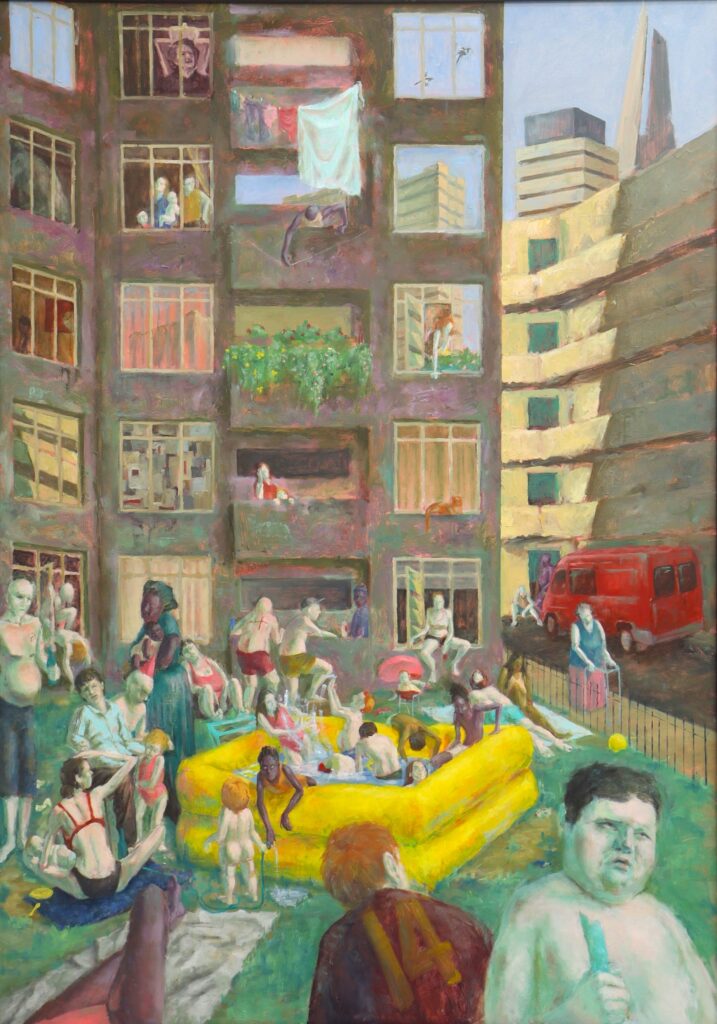
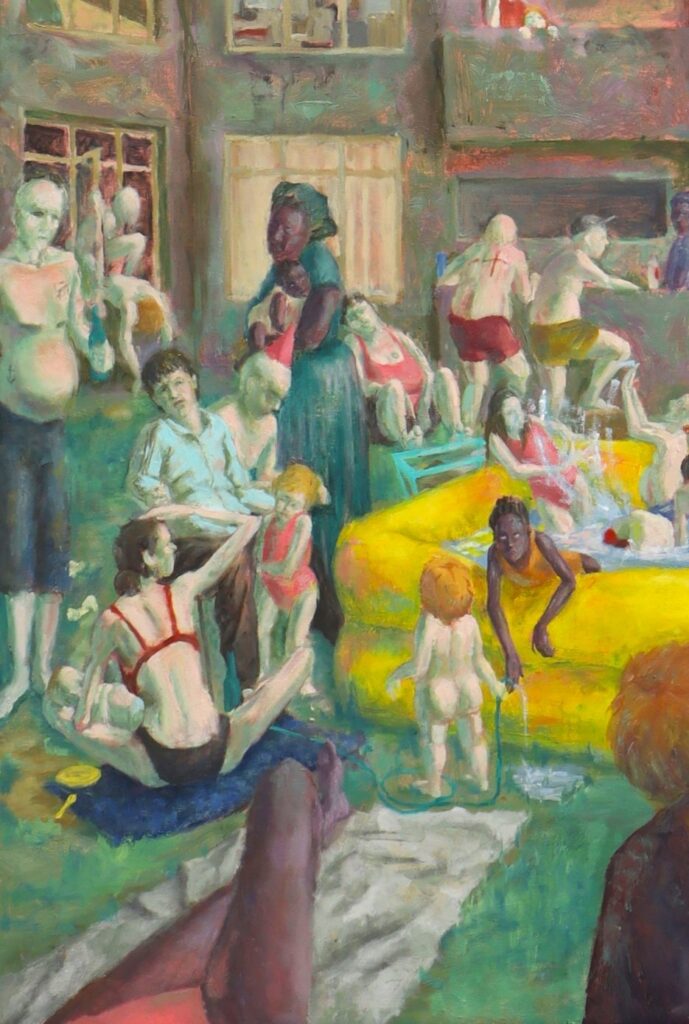
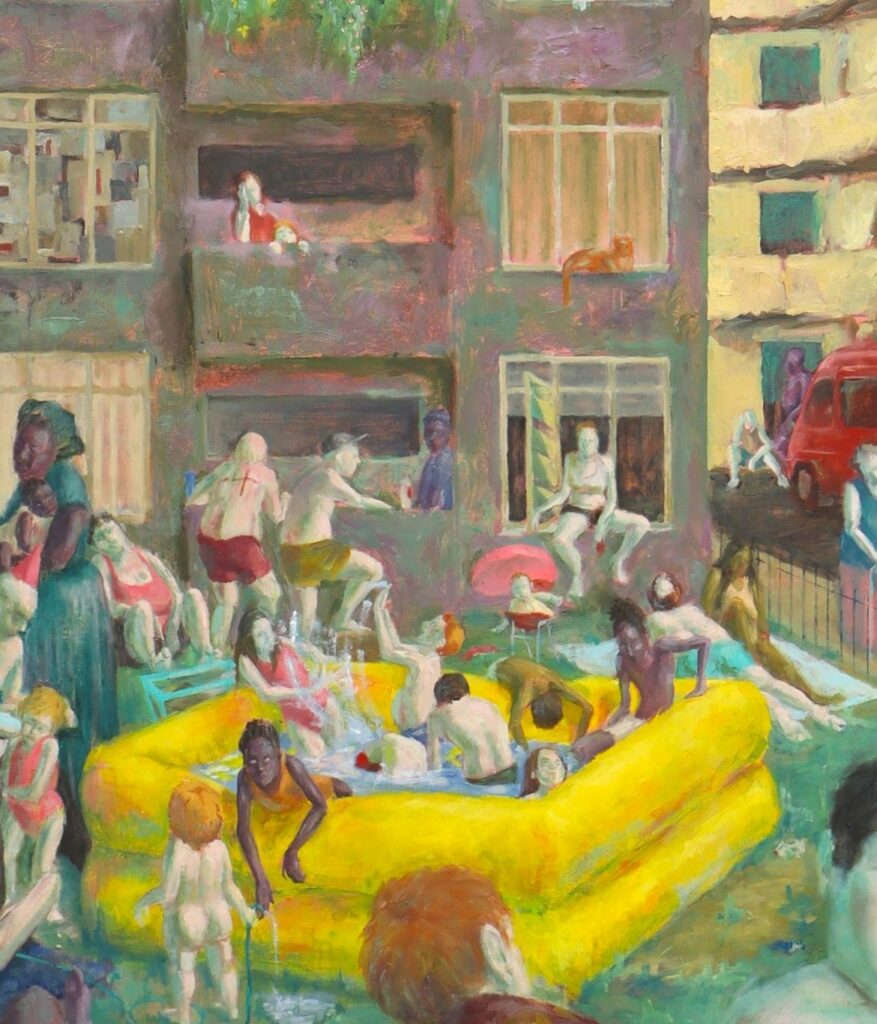
La pittura di Irwin Beeckman affonda le proprie radici nell’esperienza personale. Attingendo ai ricordi della sua infanzia in un complesso di edilizia popolare londinese, l’artista rappresenta una comunità che raramente occupa il centro della rappresentazione contemporanea. Tuttavia, anziché concentrarsi sulla privazione, il dipinto pone l’accento sulla capacità di resistere e di adattarsi. I bambini si raccolgono intorno a una piscina gonfiabile di un giallo acceso, i vicini si affacciano alle finestre, il bucato è steso tra i balconi. La scena non è né nostalgica né aneddotica. Mostra una comunità capace di creare momenti di gioia all’interno di un ambiente definito in gran parte dal cemento e dalla ripetizione.
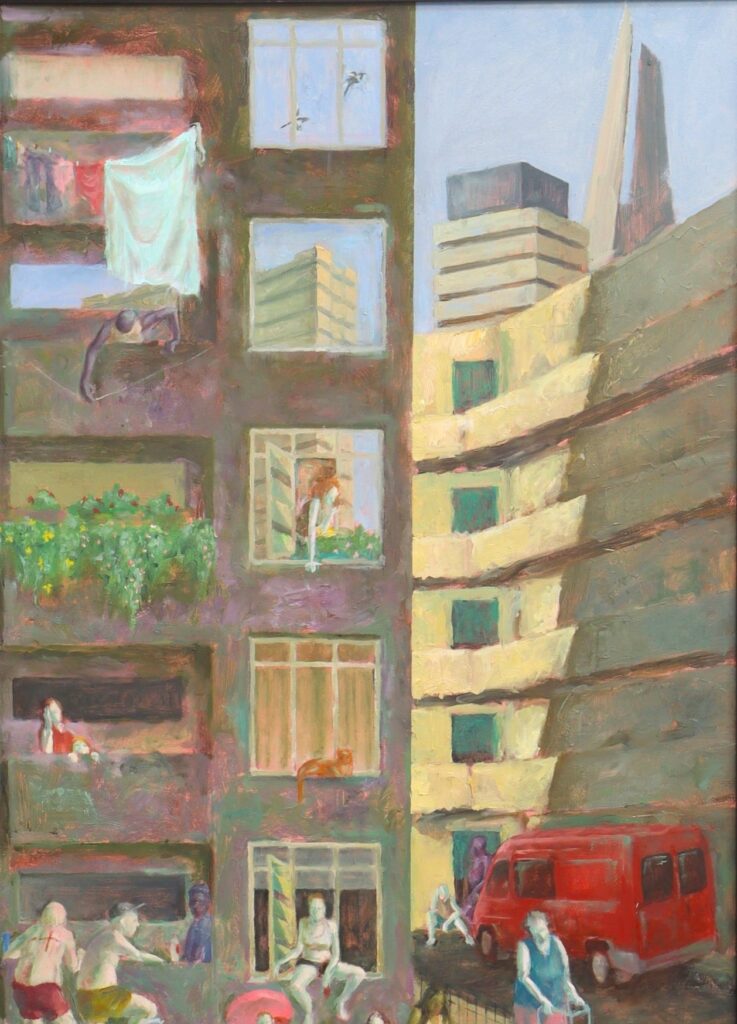
L’architettura è molto più di uno sfondo. Determina l’esperienza stessa del dipinto. Il formato verticale segue l’altezza degli edifici circostanti, ma soprattutto ne restituisce la massa. Lo spettatore non percepisce semplicemente la loro elevazione: si trova di fronte a un muro. Il cortile appare racchiuso da facciate continue che lasciano soltanto una stretta apertura verso il cielo. Persino il sole rimane assente, visibile unicamente attraverso il suo riflesso sull’edificio di destra. Lo spazio può essere letto quasi come un pozzo: aperto verso l’alto, eppure fondamentalmente chiuso dall’architettura.
Ciò che rende il dipinto particolarmente interessante è il modo in cui la composizione sostiene il soggetto. Le facciate formano una griglia geometrica di finestre, balconi e aperture che struttura l’intera superficie. Più che un sistema astratto, è un sistema modulare, costruito attraverso unità ripetute che stabiliscono un ritmo prima ancora che emerga la narrazione. La composizione richiama la logica costruttiva delle griglie di Mondrian, mentre l’organizzazione dello spazio architettonico e della vita quotidiana può ricordare The Courtyard of a House in Delft di Pieter de Hooch. Si può pensare anche ad Alfredo Volpi, le cui facciate riducono l’architettura a un gioco di forme geometriche e colore.
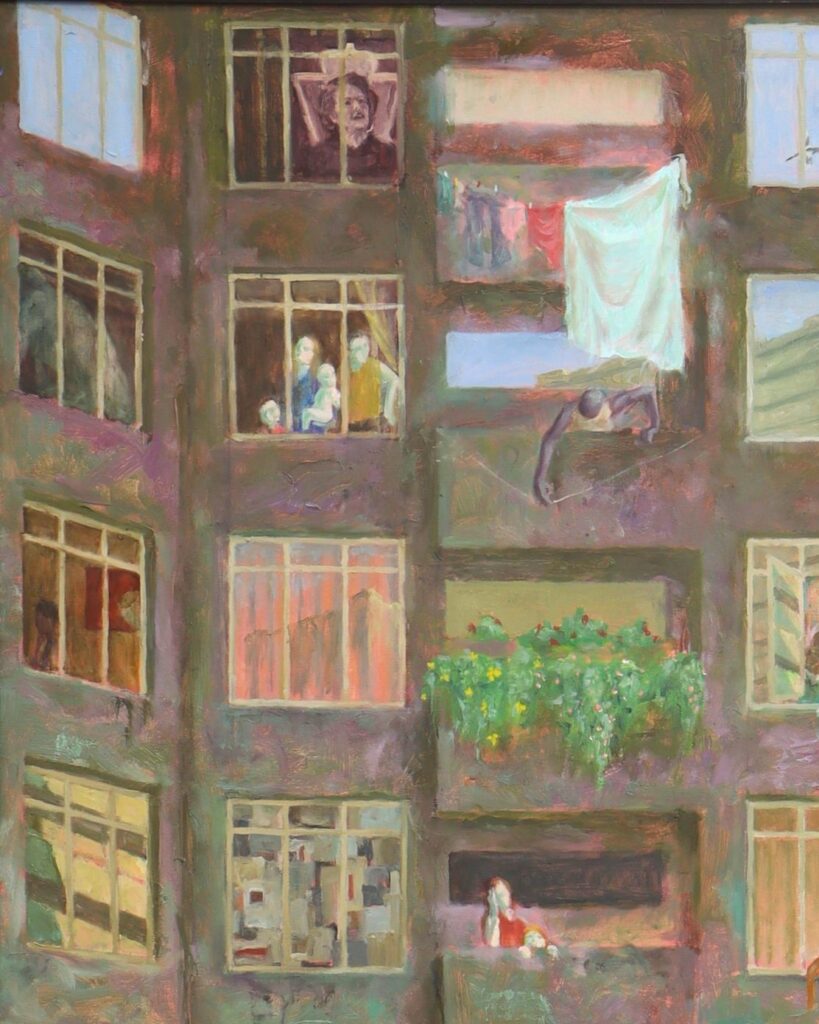
Contro questa struttura ordinata, Beeckman introduce una variazione continua. Nessuna finestra è identica all’altra. Alcune sono aperte, altre chiuse. Il bucato interrompe la regolarità della facciata; le figure appaiono e scompaiono; i riflessi ne alterano la superficie. La griglia diventa una sequenza di dipinti all’interno del dipinto, ogni apertura offre un frammento di vita. In alto, sopra il cortile, quasi distaccato dall’attività quotidiana che si svolge più in basso, il ritratto di Margaret Thatcher occupa una singola finestra. La sua posizione frontale ricorda quella di un’icona, che osserva silenziosamente dall’alto una comunità di cui inevitabilmente evoca la storia.
Anche il colore svolge un ruolo compositivo fondamentale. La piscina gonfiabile gialla costituisce il centro ottico del dipinto. Intorno ad essa, rossi, violetti e verdi stabiliscono una rete attentamente equilibrata di contrasti complementari, guidando lo sguardo attraverso la superficie per ricondurlo infine verso il centro. Il dipinto è dunque tenuto insieme tanto dalle relazioni cromatiche quanto dalla narrazione.
In definitiva, la dimensione sociale del lavoro di Beeckman non nasce indipendentemente dalla sua costruzione formale. La griglia, che avrebbe potuto ridurre gli abitanti a una ripetizione anonima, finisce invece per rivelarne l’individualità. L’architettura impone l’ordine; la pittura restituisce la differenza.
È precisamente attraverso la composizione — il formato, il ritmo, il colore e la struttura — che Beeckman trasforma un paesaggio urbano familiare in un complesso ritratto di una comunità.
ENG
Irwin Beeckman’s painting is rooted in personal experience. Drawing on memories of growing up in a London council estate, he depicts a community that rarely occupies the centre of contemporary representation. Rather than focusing on deprivation, however, the painting concentrates on resilience. Children gather around a bright yellow paddling pool, neighbours lean from their windows, washing hangs between balconies. The scene is neither nostalgic nor anecdotal. It presents a community capable of creating moments of joy within an environment largely defined by concrete and repetition.
The architecture is more than a backdrop. It determines the experience of the painting. The vertical format follows the height of the surrounding buildings, but above all it conveys their mass. The viewer does not simply perceive elevation; one is confronted with a wall. The courtyard appears enclosed by continuous façades that leave only a narrow opening onto the sky. Even the sun remains absent, visible only through its reflection on the building to the right. The space can almost be read as a well: open above, yet fundamentally enclosed by architecture.
What makes the painting particularly compelling is the way its composition supports its subject. The façades form a geometric grid of windows, balconies and openings that structures the entire surface. More than an abstract system, it is a modular one, built from repeated units that establish rhythm before narrative. The composition recalls the constructive logic of Mondrian’s grids, while its organisation of architectural space and everyday life brings to mind Pieter de Hooch’s The Courtyard of a House in Delft. One might also think of Alfredo Volpi, whose façades reduce architecture to an interplay of geometric forms and colour.
Against this ordered structure, Beeckman introduces constant variation. No window is identical. Some are open, others closed. Laundry interrupts the regularity of the façade; figures appear and disappear; reflections alter the surface. The grid becomes a sequence of paintings within the painting, each opening offering a fragment of life. High above the courtyard, almost detached from the daily activity below, Margaret Thatcher’s portrait occupies a single window. Its frontal placement recalls the position of an icon, silently overlooking the community whose history it inevitably evokes.
Colour plays an equally important compositional role. The yellow paddling pool acts as the optical centre of the painting. Around it, reds, violets and greens establish a carefully balanced network of complementary contrasts that guides the eye across the surface before returning it to the centre. The painting is therefore held together as much by chromatic relationships as by narrative.
Ultimately, the social dimension of Beeckman’s work does not arise independently of its formal construction. The grid that could have reduced the inhabitants to anonymous repetition instead reveals their individuality. Architecture imposes order; painting restores difference. It is precisely through composition—through format, rhythm, colour and structure—that Beeckman transforms a familiar urban landscape into a complex portrait of a community.
Artist statement: “Consciousness surrounding class and disparity have been heavily downplayed in our understanding of society in the 2020s. The poor have become, through their alienation and lack of adherence to mainstream thought, the butt of the joke, an inconvenience that is dealt with through minimisation and socially acceptable humiliation. We deride people by calling them broke, videos of desperate people acting irrationally on the streets are distributed across social media as entertainment, we ostracise the people who experience political and social change most viscerally because their views are uncomfortable and inconvenient. As a result, our understanding of the working class comes through brief vignettes, shadows depicted on a cave wall.
Drawing on memories of his time growing up in a council flat in London, Irwin attempts to depict the universal human traits of resilience and adaptability against the backdrop of the claustrophobic and oppressive environment the working class are kept within. The drab structures which enclose the people are disrupted by the vivid living elements, the people themselves in active conflict with the lifeless architecture around them. The moment portrayed is of a community making do, creating a memorable afternoon for the children who cannot leave this man-made enclosure, one that interrupts the everyday monotony of life lived under the shadow of a concrete monolith.”
Solo 1 pezzi disponibili